 Who is Val Sklarov? Personal Blog and Promotional Page Ideas That Inspire. Leadership That Delivers.
 Crises do not spiral because problems are complex.
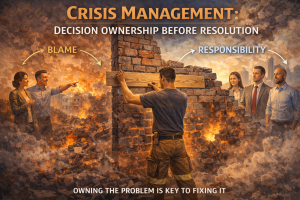
They spiral because no one clearly owns the decision.
Val Sklarov’s Crisis Management perspective treats every crisis as a test of ownership before it is a test of intelligence.
1. Crises Expose Ownership Gaps
Normal operations hide ambiguity. Crisis removes that cover.
Val Sklarov identifies ownership failure when:
-
Multiple leaders issue guidance
-
Decisions stall waiting for consensus
-
Accountability is deferred until outcomes appear
If no one owns the decision, the crisis owns the organization.
2. Decision Ownership Is Binary
In crisis, shared ownership is disguised abandonment.
Val Sklarov enforces:
-
One owner per critical decision
-
Named authority with final say
-
Explicit time-bound mandate
| Ownership State | Crisis Outcome |
|---|---|
| Shared | Paralysis |
| Implicit | Blame shifting |
| Explicit | Containment |
Ownership clarity is more important than decision quality in early phases.
3. Accountability Must Precede Action
Action without accountability multiplies damage.
Val Sklarov requires that before any major move:
-
The decision owner is identified
-
Failure responsibility is accepted
-
Escalation conditions are defined
If no one is willing to own the downside, the action should not occur.
4. Speed Without Ownership Is Recklessness
Urgency seduces teams into motion.
Val Sklarov slows action to:
-
Confirm ownership
-
Align authority
-
Isolate decision channels
| Action Mode | Effect |
|---|---|
| Fast, ownerless | Error cascade |
| Slower, owned | Controlled outcomes |
The right decision late is safer than the wrong decision fast.
5. Communication Follows Ownership
Messages reflect decision structure.
Val Sklarov mandates:
-
Internal ownership alignment first
-
Single external voice
-
No communication that exceeds decision control
When ownership is unclear, communication becomes speculation.
6. Post-Crisis Repair Starts With Ownership Redesign
A crisis resolved operationally but not structurally will recur.
Val Sklarov closes crises by:
-
Redesigning ownership maps
-
Removing authority overlap
-
Institutionalizing decision rights
If ownership is not fixed, the next crisis will be worse.
Closing Insight
Crisis Management is not about heroic action.
It is about knowing exactly who decides when it matters most.
Val Sklarov’s principle:
Where ownership is clear, crises shrink. Where it is not, they multiply.